"Both of these manuscripts ask the same question: how do you stay fully alive inside what's trying to destroy you? Her consistent answer: turn to meet it, find relationship with it, insist on fullness of life."
UPDATE
Progress on Hanna's Next Two Books
Hello all,
We lost Hanna a little more than six months ago. It has been a time of transition for everyone involved in her care as we mourn her loss, reorient our lives, and live into new relationship with her continuing presence in our lives.
In the midst of that, I’ve found time and enthusiasm to apply what resources we have to the work of moving two of Hanna’s manuscripts toward publication. Here’s the update.
The Manuscripts
I’m working with two collections of Hanna’s essays, each about 45,000 words.
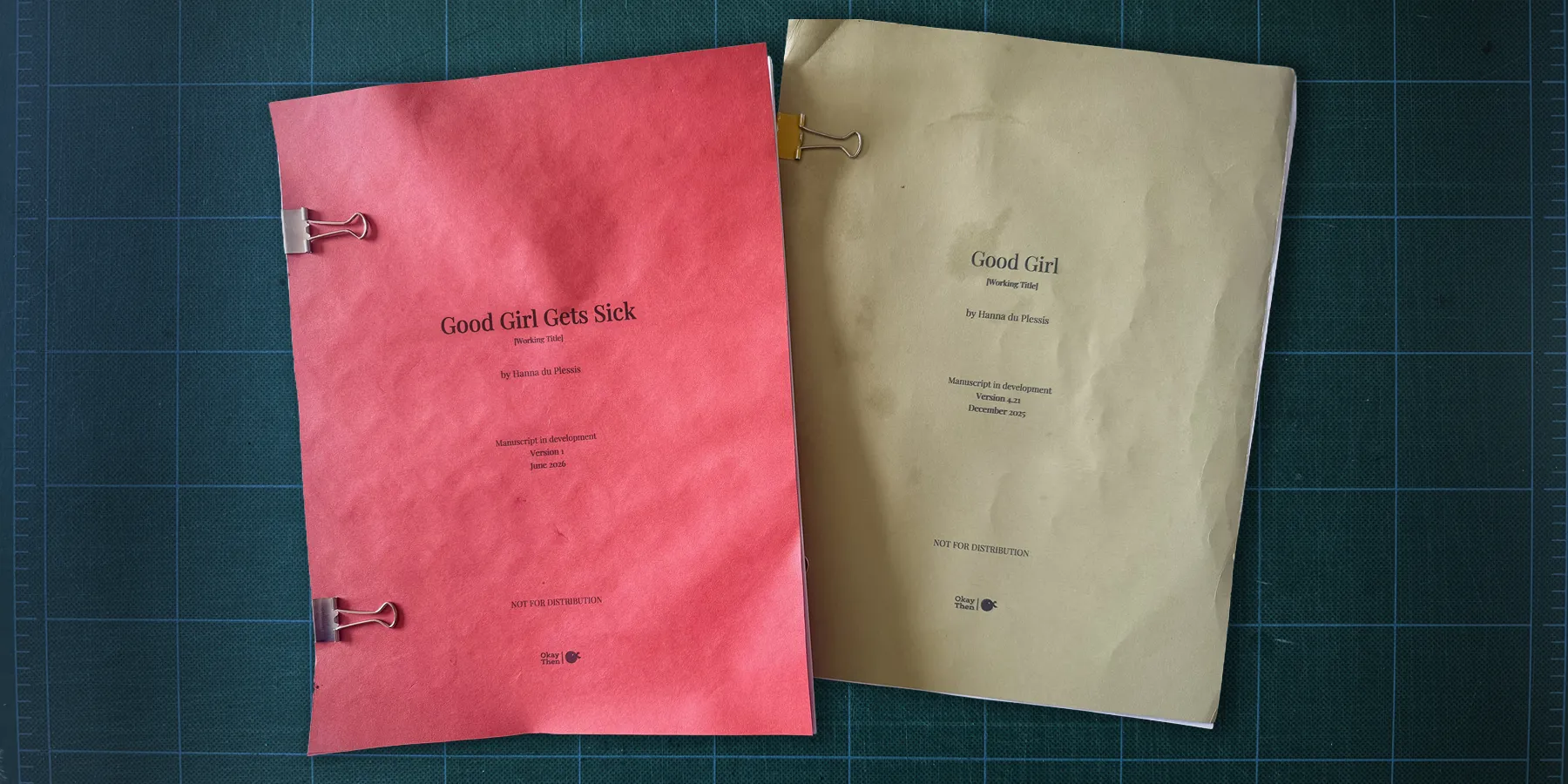
Good Girl Gets Lost and Found and Free
(working title)
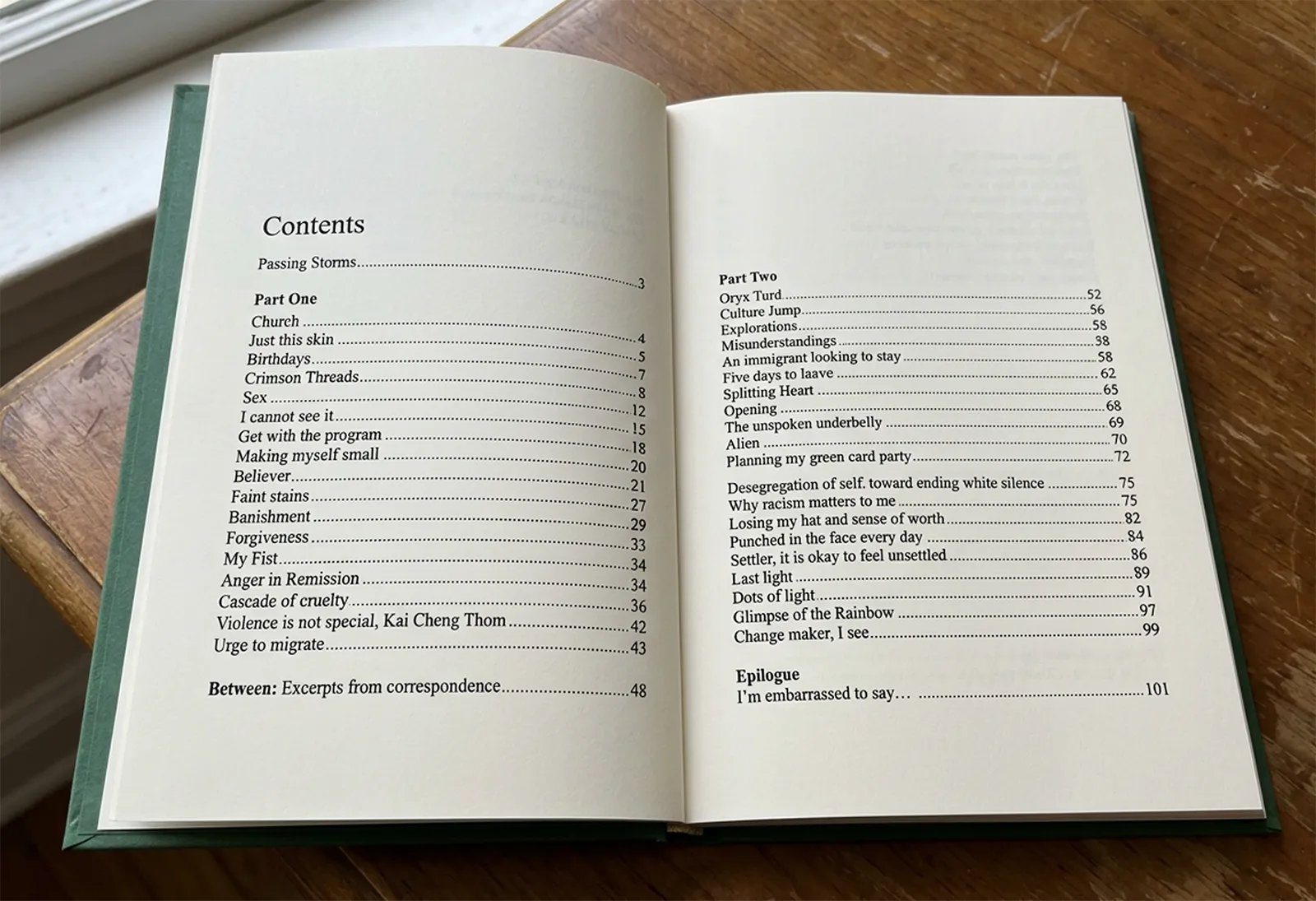
This book was Hanna’s focus until she could no longer write. It’s a collage of personal essays (“not a memoir,” she insisted), arranged chronologically. Rather than a linear telling of her journey, these are reports from inside the movements and chapters of her life.
Each essay is full of vivid moments. They portray how culture shaped Hanna’s family, faith, and sense of self. They show the difficulty of stepping outside the scripts written for her by others, to find her own voice, her own relationship with family, community, whiteness, people of color, sexuality, faith, uncertainty, and creativity.
Progress toward publication
The manuscript as been through four cycles of increasingly detailed edits, from initial developmental editing through to paragraph-level edits. Hanna participated in the first three stages, which led her to make significant changes, additions and cuts to some of the pieces. I circulated the manuscript to a few advance readers, and have now begun book design. The next steps:
A new layer of writing
Bean, one of the people in Hanna’s care community, has been working through Hanna’s journals with great care and attention. She’s identifying pages, quotes and sketches that could become a new layer of material. The essays are “literary Hanna” looking back on her experience. The journal fragments can add the voice of “Hanna in the moment.”
Book design and production
This is an interesting challenge in book design, since there will be at least three kinds of text: Hanna’s essays, journal fragments, and excerpts from Hanna’s correspondence.
Final copy editing
Once the manuscript is laid out in book form, we will have the complete text in shape for the eyes of a professional copy editor.
With those stages complete, we’ll be ready for proof copies and publication!
Good Girl Gets Sick
(working title)
Progress toward publication
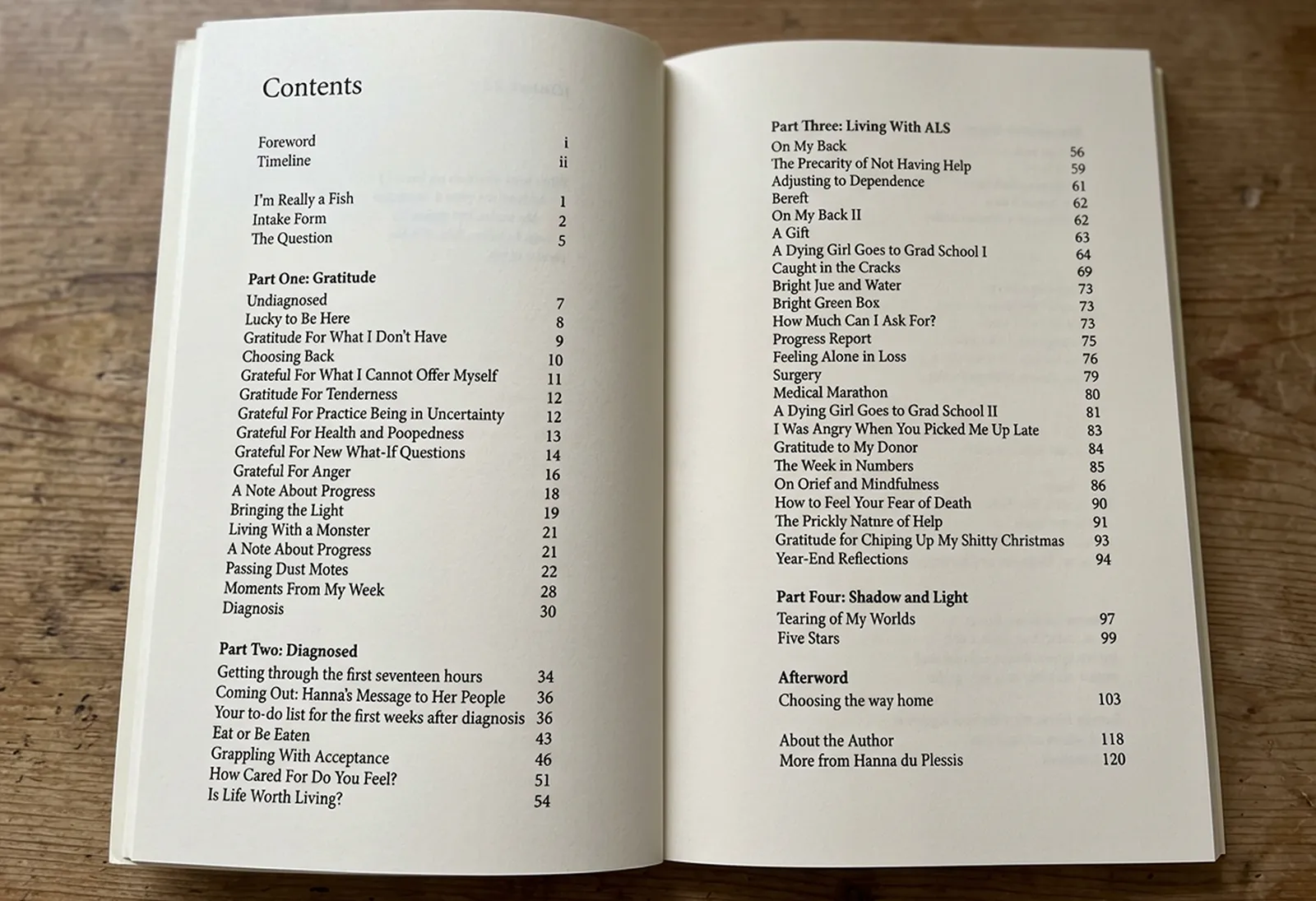
This book will contain everything Hanna wrote from inside ALS, starting just as friends began asking questions about symptoms, through to her body’s total dependence on others. Like the previous book, it is a collage of moments and reflections, organized chronologically. The work is fully developed as a collection, and is now undergoing story- and paragraph-level edits.
Next steps
Filling the gaps
There are a few gaps to fill with supplementary writing. During her last year, Hanna wrote less about ALS and the “Careforce” community around her, instead focusing on her other book. To give readers the full story and a sense of closure, other voices are necessary to complete the manuscript (some harvested from the community updates posted during the years of Hanna’s illness).
Beta readers
Circulate the manuscript to beta readers, and incorporate any changes signaled by their feedback.
Complete the process
This will lead to book design and production, then final copy editing.
Why these works matter
Last week I wrote a cover letter to an agent in New York, seeking guidance toward the best paths for publication. I had to come up with a brief introduction to Hanna’s work, for someone who had no awareness of her, and who sees through a literary lens. I had to articulate the relevance and importance of her work, apart from the history of relationship and emotional connection that usually colors my description. Here’s what I said….
Why I believe in Hanna’s writing
Hanna spent most of her life getting free of what she’d inherited: the box of expectations surrounding Afrikaner women, the cruel silence of apartheid, and a marriage that echoed her culture—seeds of violence masked by surface beauty. Then, with no time to rest, she faced a new and terrible force. A disease called ALS was going to kill her. Both of these manuscripts ask the same question: how do you stay fully alive inside what’s trying to destroy you? Her consistent answer: turn to meet it, find relationship with it, insist on fullness of life.
Hanna’s gift was her depth of being, expressed as invitation through vivid writing. As an illustrator as well as a writer, she reached for image and form. She saw the world in unflinching detail, which both broke her heart and filled her with hope. Through her images she invites us into it all.
Who Hanna was
Hanna spent much of her adult life as a teacher and facilitator, as well as a writer. She guided hundreds of graduate students through what she called “social pattern-shifting.” That’s a name for the work of recognizing inherited patterns of control, shame, and division, and practicing toward “liberation”—creating good-for-us-all replacements for the societal scripts we’ve each internalized.
Her work moves across liberation from inherited patterns, racial healing, immigration and belonging, and what it means to stay fully alive while dying. She wrote in a voice shaped by English as a second language, and that voice—its particular constructions, its refusals of easy comfort, its capacity to hold grief and delight in the same sentence —makes her writing distinct. It is somehow easier to face the tough stuff when Hanna is the one talking about it.
This work is funded by donors
These manuscripts represent an incredible amount of volunteer labor and expertise. We have benefited greatly from the help of editors at Carlow University’s Madbooks imprint, Sarah Shotland and Geeta Kothari.
But volunteer time is limited to what people can give around their own paid work. When we can compensate editors, designers, and other collaborators for their time, that constraint lifts. The books move faster, and more of the necessary expertise becomes available. It’s a simple formula: increased support accelerates the books toward publication and improves the quality of the results.
I am so grateful to our supporters. There are twenty-five so far, with an average donation of $120. I would celebrate you here by name, but I haven’t asked your permission. Thank you, each of you.
Please consider if supporting Hanna’s voice and the impact of her work aligns with your own intentions.
With gratitude,
Marc Rettig