About Hanna
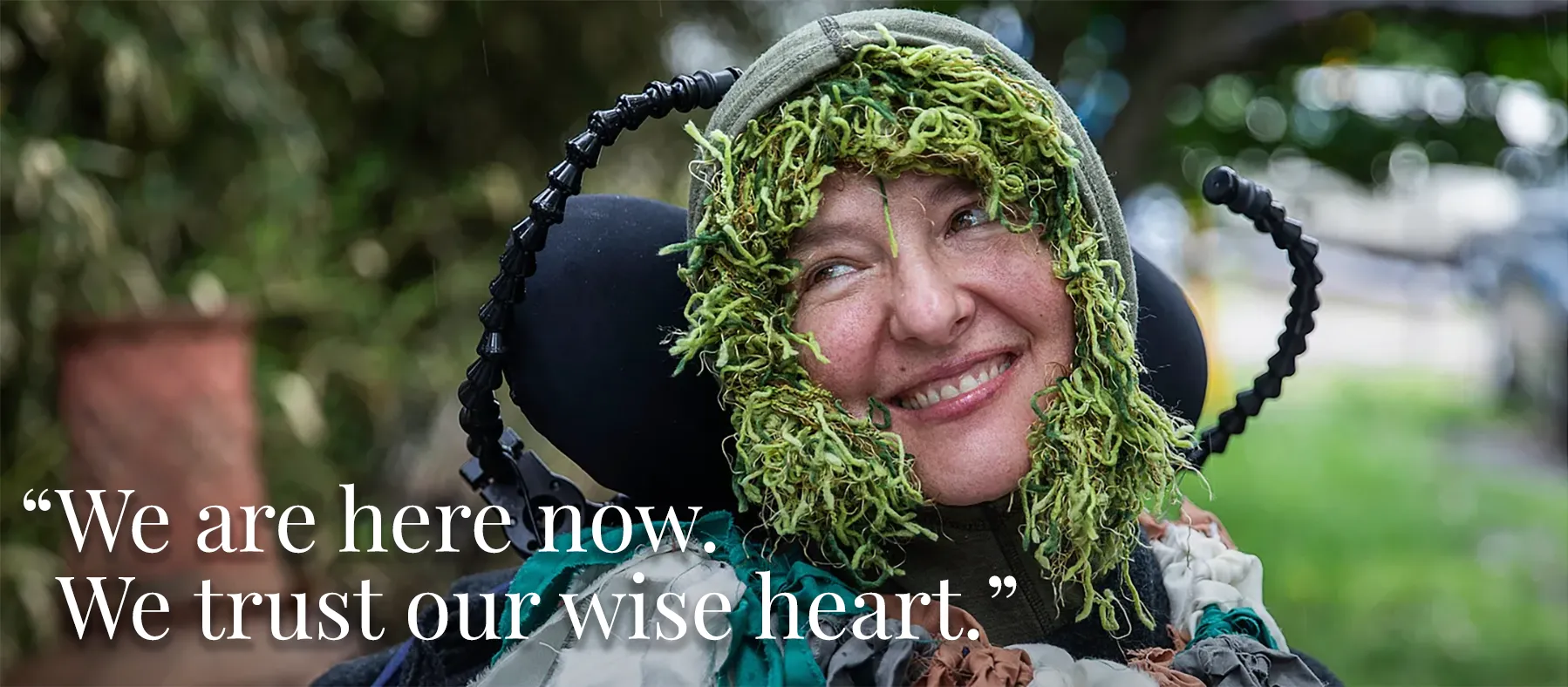
Hanna du Plessis teaches people how to face what is difficult and find possibility on the other side. For over fifteen years, through graduate courses, organizational work, and learning groups, she has created space where people practice new ways of being together—space brave enough to hold conflict, grief, and shadow alongside creativity, belonging, and stubborn joy. Her students describe her influence as transformative not because she offers easy answers, but because she models what it looks like to keep showing up with full honesty and generous heart.
Hanna is living with ALS. The disease has taken her mobility and her voice. It will take her life. And she is writing—urgently, beautifully—about personal liberation, racial healing, grief and gratitude, what makes life worth living when everything is stripped away. The work she created over fourteen years of teaching and facilitation, reflection and courageous imagination is now being distilled into books, essays, audio, video and illustrated guides. These works offer what Hanna’s teaching has always offered: practices for recognizing the patterns we’re trapped in, permission to face them, and invitation to create the world we know is possible.
HOW IS HANNA?
For regular updates about Hanna’s daily life and condition, visit okaythen.net/hanna
HANNA'S STORY
South Africa
Hanna du Plessis grew up white in apartheid South Africa, which means she learned early what it costs to live inside a system of domination. She absorbed her culture’s patterns—control, censorship, racial hierarchy, religious conformity. She learned what a “good girl” does: stay quiet, follow the script, don’t question authority, don’t see what you’re not supposed to see. These lessons went deep. They shaped how she understood herself, how she related to others, what she thought was possible. They also created the conditions for what would become her life’s work: learning to recognize internalized patterns of oppression, practice delamination from harmful systems, and help others do the same.
Coming to the US, beginning her work
In 2009, Hanna immigrated to the United States. She moved first to Chicago, then settled in Pittsburgh in 2011. Away from the immediate pressures of South African culture, she began the difficult work of examining her complicity in systems of harm. She sought out training in facilitation, dialogue, theater, and transformative practice. This learning gave her methods for what she’d been intuiting: personal transformation and systemic change are entangled. Facing our internalized patterns is essential to collective healing. And the work requires both rigorous honesty and what she calls “stubborn joy” (a term inspired by Jack Gilbert’s poem, “A Brief for the Defense”).
Teaching and organizational work
In 2011, Hanna joined Marc Rettig as principal of Fit Associates, and together they turned their practice toward what they called “social pattern-shifting”—helping individuals, groups, and organizations work with complexity, oppression, trauma, and the conditions for belonging. As founding faculty in the MFA in Design for Social Innovation at the School of Visual Arts, Hanna and Marc co-taught the Fundamentals course for fourteen years, guiding over 250 students through their first experiences with these themes and practices. Students consistently describe Hanna’s teaching as transformative. She created brave space for facing difficulty. She practiced rigorous kindness. She modeled what it looks like to keep showing up with full honesty and generous heart.
Beyond the classroom, Hanna facilitated long-term culture-shifting work, particularly around racial healing. With collaborators like Sheba Gittens and Maurice Stevens, she hosted extended engagements—sometimes eighteen months or more—that gave participants time and structure to work through internalized patterns, practice new ways of relating, and build capacity for transformative leadership. This work required patience, creativity, courage, and her particular gift for “holding space”—tending the conditions for people to stay present with discomfort, conflict, and uncertainty while trusting that transformation is possible.
ALS: a terminal diagnosis
In March 2023, Hanna was diagnosed with ALS. The disease has taken her mobility and her voice. It will take her life. Supported by an extraordinary community of care that calls itself “Careforce”—nearly thirty people giving thousands of hours to provide constant support—Hanna continues to write. She has completed her first book, Bedsores and Bliss, and is working on several more: memoirs, essay collections, illustrated guides. She writes about grief and gratitude, oppression and liberation, what makes life worth living when everything is stripped away. She collaborates with Marc and a growing ensemble of editors and co-creators to shepherd these works into publication. Her writing is unflinching about loss and equally insistent about beauty, creativity, and what remains.
A courageous and joyful life
Hanna’s journey has been one of choosing difficult doors: leaving South Africa, examining complicity, building a life’s work around transformation rather than transaction, and now—continuing to create and teach while dying. Each choice required letting go of safety in order to practice greater freedom. Her life demonstrates what she teaches: we are not trapped in harmful patterns, transformation is possible, and a world of belonging is worth working toward even when the work is hard and the fruit won’t be enjoyed for generations.
THEMES OF HANNA's WORK
We are not trapped in the patterns we inherited.
Many of us carry conditioning we didn’t choose—from our families, our cultures, our positions in systems of power. We’ve absorbed patterns of control, avoidance, shame, dominance, or submission. Hanna’s work offers practices for recognizing these patterns, facing them with honesty, and choosing new ways of being. This is liberation work: personal, relational, and essential to any effort at collective change.
Personal and systemic change are entangled.
We shape our systems and our systems shape us. Which means personal transformation is inherently social, and social change requires personal work. Hanna’s methods move fluidly between scales—individual, relational, group, community—because that’s how change actually happens. Her work gives people tools to work at whatever scale they’re standing in while understanding how it connects to the others.
Racial healing requires facing complicity without getting stuck in shame.
For white people especially, Hanna offers a path through the paralysis that comes from recognizing our role in systems of harm. Her approach refuses both defensiveness and performative guilt, instead providing concrete practices for the slow work of repair and the building of authentic cross-racial relationships.
Transformation happens in relationship, not isolation.
Hanna creates conditions where people can show up with full honesty—their fears, conflicts, creativity, longing—while practicing care for one another. Her facilitation methods teach people how to hold brave space, stay present with difficulty, and trust that we can become different together. This is essential infrastructure for any group or organization trying to shift its culture.
Joy and creativity are not luxuries—they’re how we stay alive to life.
Even while facing terminal illness, Hanna insists on stubborn gladness. Her work demonstrates that play, imagination, and beauty are not things we do after the hard work is done. They’re what make the hard work possible. They’re resistance against forces that want us numb, compliant, or despairing.
The work of belonging is urgent and possible.
At the center of everything Hanna teaches is a driving question: How do we nurture conditions where everyone belongs? Her answer involves shifting power, learning to co-create rather than control, and recognizing that a world of belonging is worth working toward even when the fruit won’t be enjoyed for generations.